By Kara Mae Adamo.
Nearly 50 years have passed since the famous break-in, and yet we still immediately associate Washington DC’s extravagant Watergate Hotel with what is widely considered the single greatest scandal in our nation’s history.
Indeed, every time a disreputable story breaks–and, as of late, they seem to do so on the hour–the key word of that story’s headline becomes a prefix to the hotel’s name:
Gamergate, Nipplegate, Russiagate, Deflategate
As far as our etymology is concerned, every single scandal from here-on-out is merely a derivative of the one that ocurred on June 17th, 1972.
The act forever changed both history and our nation’s lexicon. Today, you cannot hear either the name “Nixon” or the name “Watergate” without immediately thinking of the other: the place and the man have melded together, becoming instead a permanent amalgamation of two initially separate entities forever bound to one another.
The DNC break-in was not the first time the hotel’s name was whispered in corners of our nation’s capital. From the moment Italian architect Luigi Moretti revealed his design plans in 1961, the Watergate was the source of social controversy.
Many of DC’s more affluent residents were partial to the city’s neoclassical architecture and turned their noses at the “blasphemous” modern blight on what they considered a comprehensively designed city. One traditionalist was even quoted saying that the hotel’s modern design was, “as appropriate as a strip dancer performing at your grandmother’s funeral.”
Nonetheless, construction began in 1963 and by October of 1965, the Watergate opened its East building, a residential space, followed by the hotel’s grand opening on March 30th, 1967.
Despite initial apprehension regarding the design of the structure, the hotel was an immediate sensation among international royalty and Hollywood elites like Elizabeth Taylor.
But what of the hotel now?
The Watergate switched hands a number of times throughout the 80’s, 90’s and early 2000’s. It seemed that a number of business deals went sideways and, for about a decade, it was closed completely to the public.
Then, after significant renovations totalling about $128 million to update the 277000 square foot complex, the doors re-opened on June 1st, 2016 with a fresh look and a rather light-hearted attitude toward the scandal that took down a presidency so many years before.
Even their cusomer service number ends in 1972, and you have to sort of respect that level of shade.
Joking references aside, the Complex is as stunningly beautiful as ever, boasting one of my favorite lobby bars in all of Washington DC: The Next Whiskey Bar.
 When you walk into the main entrance of the hotel, a baby grand piano sits among plush cushions and glittering silvery metallic columns that curve, creating movement throughout the space. Then, beyond that point, a soft glow catches your eye.
A row of picture windows overlooking the  courtyard line the wall leading to a proper whiskey bar with all of polished wood and aesthetically unique seating one could expect from a building that made its name as a progressive staple long before it was the backdrop for heated political controversy.
It is to the right of that classic bar that the glowing begins, and its source is nothing short of breathtaking.
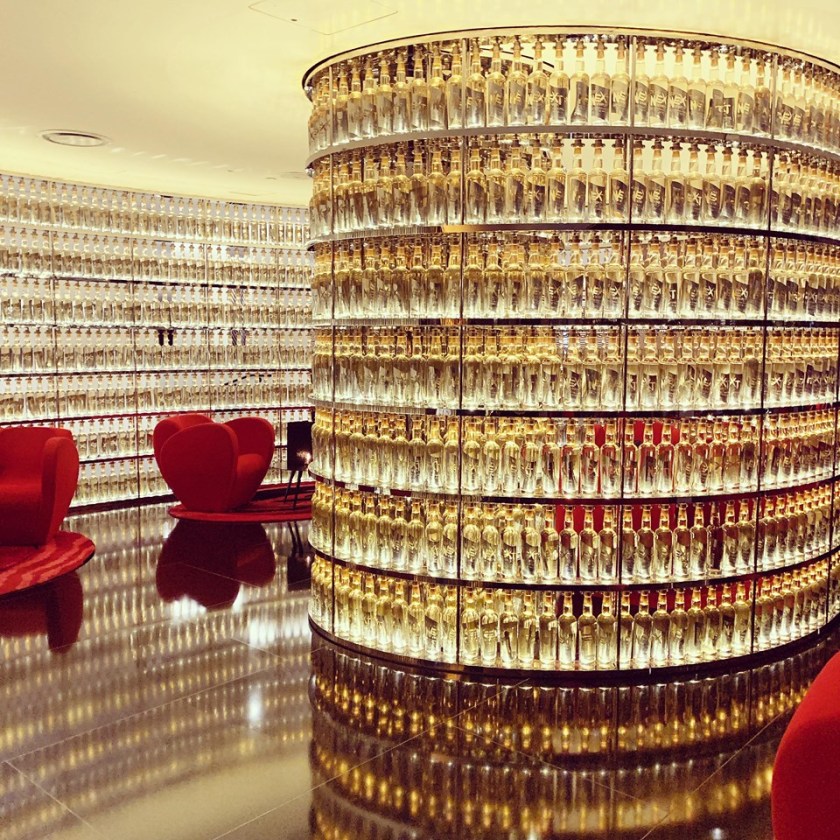
Thousands of perfectly lit whiskey bottles create a swirling wall of golden light to create a 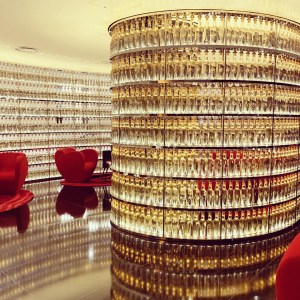 positively illuminated amber Fibonacci-inspired spiral enveloping a space, making the seating inside all the more intimate. Inside that spiral of glowing, opulent whiskey, are sets of low tables and comfortable red chairs designed by Ron Arad in collaboration with Moroso.
The effect is nothing short of magnificent.
My friends and I chose to sit at the bar itself to enjoy our respective whiskeys.
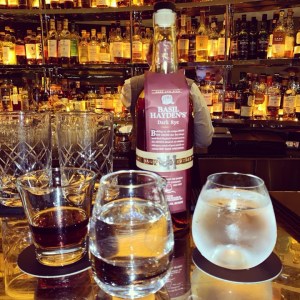 I went with one of my new favorites for the last year: a Basil Hayden Dark Rye. Aged in Port Wine barrels, this aromatic delight is a blend of Kentucky straight rye, Canadian rye, and California port-style wine. It’s as smooth as silk and makes a hell of a Manhattan if you ever want to branch out and make it a cocktail.
Generally, I drink mine neat with a water-back (this is where you enjoy the beverage at room temperature with room temperature water off to the side. You gradually drip small amounts of the water into the whiskey, awakening the aromas. This is how they drink Scotch in Scotland and it’s the only way I will enjoy a whiskey).
The Next Whiskey Bar also has an excellent bar menu, and I would personally argue that 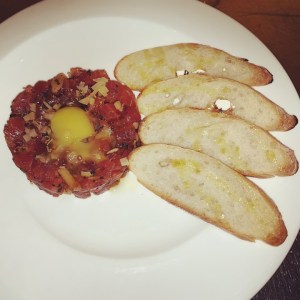 their tuna tartare is the best you’ll find in the city. It’s served with lemon preserves, harissa, fresh mint, almond slivers, medjoul dates, and–the real kicker that sends it over the top–a delicate little quail egg yolk.
A must-see for whiskey drinkers, the Watergate also sports a brand new rooftop bar that features heated igloos with bottle services available on request during the winter, although I would jump on that list as soon as you can. They are generally booked far in advance. You can also enjoy hand-rolled cigars from their expertly curated selection while taking in the night air from the terrace.
If you’re looking for a truly exquisite experience, I suggest dropping in. It’s amazing what they’ve done with the place.
Plus, many famous politicians and judges call the Watergate home while they’re in Washington DC, including none other than our contemporary fan-favorite: Supreme Court Judge and Queen of Dissent, Ruth Bader Ginsburg.
Maybe one day I’ll run into her and buy her a drink?
A girl can dream.
Until next time,
Cheers.
 Kara Adamo is a bartender, booze nerd, and booze writer. She is the author of Fancy Grape Juice: De-Snootifying the World’s Snootiest Beverage; Artimals: Coloring the Whimsical Wild; and Brews & Hues: A Coloring Book About Beer. Adamo currently lives in Washington DC.
 Karita's Travels