
By Kara Mae Adamo
I grew up in a northern family that was transplanted to Florida before I was born.
When I was a kid, this resulted in being called a “Yankee,” though I’d lived in Florida my entire life up to that point. The sentiment was clear: my family, despite my birthplace, was from elsewhere…from “up north,” which in Florida could really mean anything.
My mom was from Elmira, New York…a place I often joke is, “the part of New York that wants to be Pennsylvania”. Her accent rounds off at certain vowels, but for the most part it’s dimmed down. She doesn’t sound Southern, but you can tell she isn’t exactly from Manhattan, either.
My dad is from Jersey. More specifically: my father is from Rutherford, a small town that eventually became home to Giants’ Stadium and it is, as far as I could always tell, the part of New Jersey that wants to be New York.
My dad’s accent is much more pronounced. You take one look at him and the stereotypical Jersey-Italian vibe comes off in waves. He moved to Florida when he met my mom and he’s stayed there ever since, but his roots are clear: a northern boy from just outside of NYC. A Springsteen listener who spent his early ears hanging out in the big Apple as often as he could.
It is because of my dad that I ever knew about McSorley’s Old Ale House. It was the first real bar I ever went to and its unique atmosphere stayed with me.
My paternal grandmother, Lillie, passed away in the beginning of 2006. That week, my Great Uncle Bob on my mother’s side was in a fatal car accident, making it a double whammy for my family. Because my parents are both from up north, we made a trip to both funerals at the same time.
To lighten the mood, we took a trip to NYC. We wound up meeting with my dad’s childhood friend, Billy, and everyone made a stop at McSorley’s.
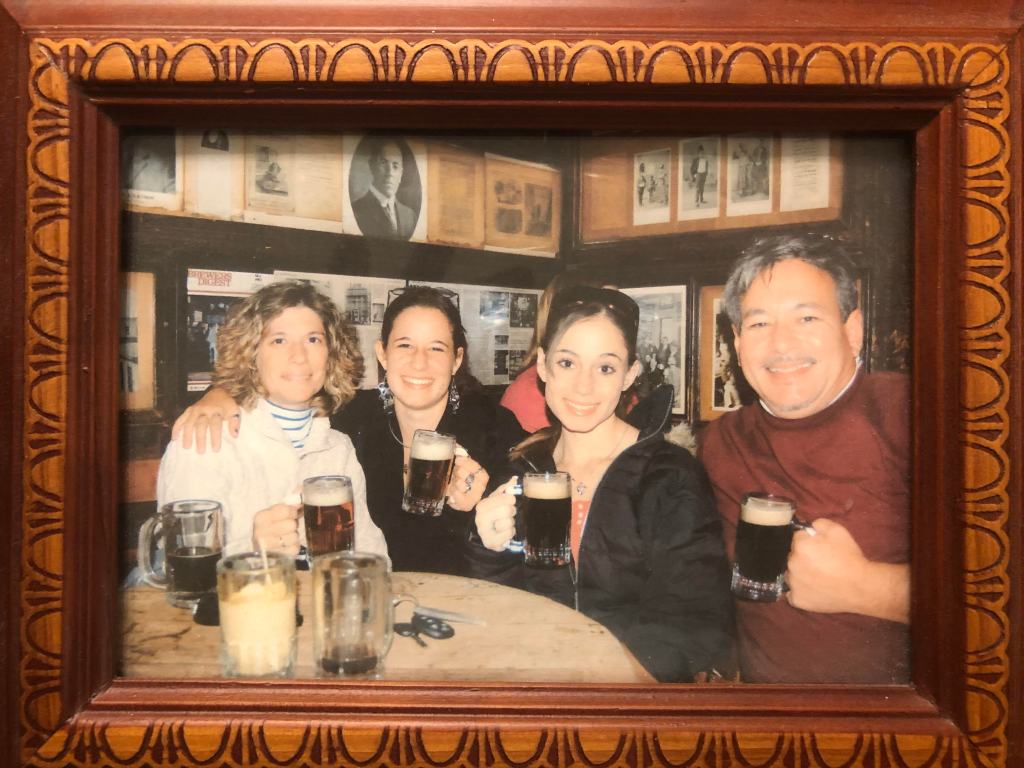
I was still eighteen, so I couldn’t share a beer with the adults, and my sister (two and a half years my junior) definitely couldn’t partake, but we did end up staging a family photo anyway. The sentiment was clear: McSorley’s was a New York staple and it was unique and important enough for my parents to bring us.
The most defining feature at the time was the dust that covered the bone-decked gas lamps that hung above the bar. You actually had to do a double-take. The coating was so thick and so strangely beautiful that it almost looked like a design feature: a cap-tip to the pub’s history and a snubbed nose to conventional white bread cleanliness and convention.
How very New York.
The dust had accumulated since, according to general rumor, the year McSorley’s opened: 1850.
That means that, at the time of Abe Lincoln’s presidency, not only could you walk into McSorley’s and have a beer…but you would have seen the dust on the gas lamps then, too.
Kind of incredible, really. The legend says that each wishbone represents those who do not return from whatever various war we’ve managed to participate in, dating back to the Civil War itself. John McSorley, started the trend and it was carried out by Irishman Matty Maher, who bartended, managed, and owned the bar from 1964 on. Maher removed the dust in 2011.
Maher, who passed away this week, was something of an icon for the notorious East Village ale house. It was Maher who allowed women into the previously male-only haunt and later banned smoking. When confronted on any issue regarding his establishment, Maher would back down to no one and was once described by journaist Rafe Bartholomew as, “a five-foot-eight spark plug.”
Maher watched as his beloved bar made the slow–and often somewhat painful–transition from Old New York to New–a process that many die-hards would argue dilutes the culture and uniqueness of historic cultural staples like McSorley’s in favor of the bland, gentrified “sameness” sweeping over the country like an overtly corporate, unimaginative, over-Windexed fog.
To that respect, Maher–and, in turn, McSorley’s itself–remained a resiliant stronghold: evidence of a firm belief that quirks and rough edges have their place, too.
To me, McSorley’s was a window into a somewhat theatrical perception I’ve always held of my father’s pre-Kara world. Sitting there with my diet coke at eighteen, I watched as he and his friends laughed about the dust on the chandeliers and clinked their glasses in that cavelier, humored way that Jersey and New Yorkers all seem to attain when talking about something they know would ruffle the feathers of outsiders but they themselves find endearing. The ballsiness of the place: the sheer refusal to back down and conform was, to me, a brick-and-mortar example of the culture that shaped my dad.
And, I guess, it sort of still is.
Rest in Peace, Matty Maher. New York will miss you.
Cheers.

Kara Adamo is a bartender, booze nerd, and booze writer. She is the author of Fancy Grape Juice: De-Snootifying the World’s Snootiest Beverage; Artimals: Coloring the Whimsical Wild; and Brews & Hues: A Coloring Book About Beer. Adamo currently lives in Washington DC.
 Karita's Travels