
Of the many temples we encountered during our trip to Japan this year, none shone brighter in our minds than the infamous Kinkakuji Temple–not least of all because it’s completely covered in gold.
A former retirement villa of the shogun Ashikaga Yoshimitsu, Kinkakuji–originally called Rokuonji–is located in northern Kyoto. After Yoshimitsu’s death in 1408, the villa was dedicated as a zen temple of the Rinzai sect, per his dying wishes.
This became a sort of family tradition. His grandon, Ashikaga Yoshimasa, later built the Ginkakuji temple: a silver pavilion matching kinkakuji in style, located on the other side of the city.
Kinkakuji is one of Japan’s National Special Historic Sites. It is a National Special Landscape and is one of 17 locations included in the Historic Monuments of Ancient Kyoto.
The thing about this temple is that it’s sort of a survivor: it’s the only building left from Yoshimitsu’s retirement villa. It’s burned down multiple times over the years, including two different times during the Onin War–which was a civil war that absolutely destroyed the majority of Kyoto. It also burned down in 1950, when a crazed 22 year old monk set it on fire before attempting (and failing at) suicide.
What you see in my photos is the rebuild, completed in 1955.
During Yoshimitsu’s day, the Kitayama culture was comprised of enormously wealthy aristrocrats, and Kinkakuji was built to celebrate that wealth.
Each floor was designed to represent a different architectural style.
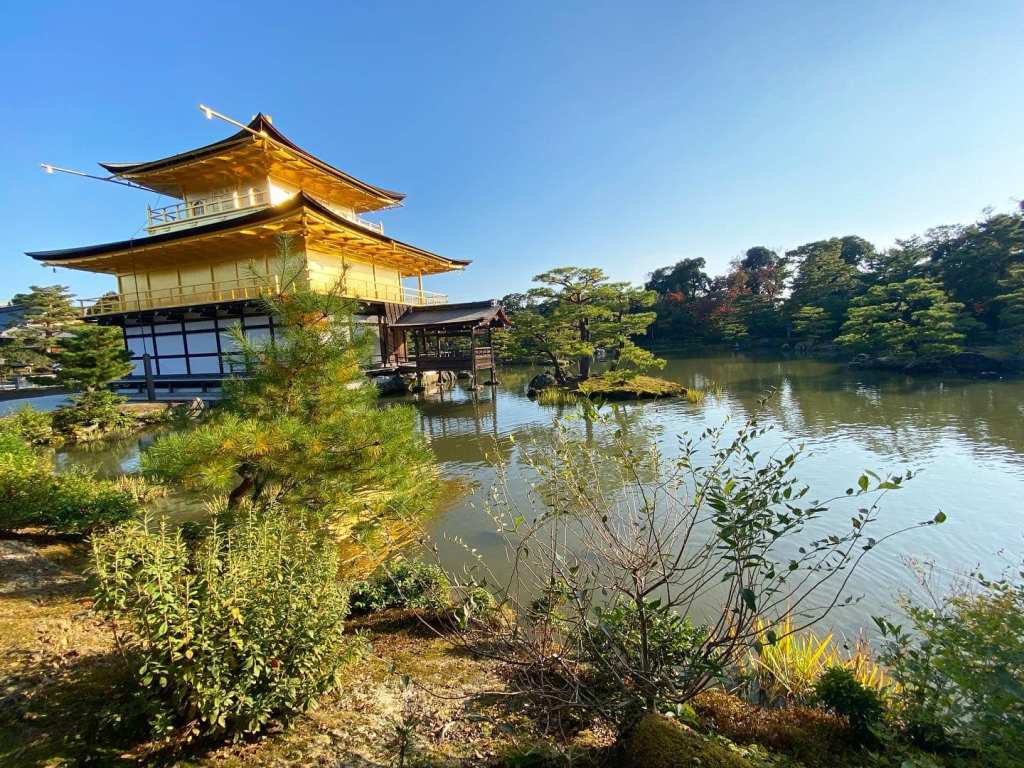
The first floor, indicative of the Shinden style, is made of natural wood and white plaster. This floor is meant to celebrate the Heian period. Here, if you look closely from across the pond, you can see statues of both the Shaka Buddha and Yoshimitsu himself.
Above this first level, you’ll find the first of the two golden levels. This one nods its head to the Bukke architecture used for samurai residences. There are statues inside, though you won’t be able to see them, as they are not open to the public. The main statue is of a seated Kannon Bodhisattva–the goddess of mercy. Here, she is surrounded by the Four Heavenly Kings, or Shitennō.
The top floor, also covered in gold leaf, is built to resemble a Chinese Zen Hall. This one, gilded inside and out, is topped off with a golden phoenix.
Oddly, despite the triad of architectural styles, the structure looks cohesive: a balanced blend of important pieces of history and culture, standing firmly along a charming body of water, called Anmintaku Pond.

According to legend, this pond never dries up. In the center of this stands a stupa, which symbolizes the Hakuja, or “White Snake.” The Hakuja, supposedly, controls the waterways. Along the trails surrounding this coveted spot–and the temple proper–are many other statues, where people will often toss coins for luck. After many attempts, Jeremy managed to land a coin directly in one of the smaller parts of a statue before taking a number of videos of the trickling waterfalls that run into Anmintaku Pond.
Lucky or not, the pond IS home to a slew of beautiful koi fish, which dart around the banks. It’s also home to a number of unique mushrooms, which Laura–who, it turns out, really loves macrophotography, was fascinated with.
We strolled past many different gardens, many of which date back to Yoshimitsu’s day. Eventually, we found the Sekkatei Teahouse, which was added during the Edo Period (which began in 1603 and lasted all the way up to 1867, a full two years after the American Civil War, which means Lincoln was alive during that time period, for context.)
This small teahouse was built in honor of an historical visit by Emperor Go-Mizuno-o. The building is intentionally simple so that the guest could focus on the tea ceremony better.
I like that, true to their fashion, the Japanese thought of everything including ADD centuries before it was a thing.
This teahouse burned down in 1874 and was rebuilt ten years later.
Guests to the golden temple are invited to enjoy matcha tea and various sweets throughout the external tea garden, located just outside of the official temple grounds. There, you’ll find a smaller temple that has a statue of one of the Five Wisdom Kings: Fudo Myoo, the protector of Buddhism.
Watching the sunlight glinting off of the gold-gilded walls of this absolute masterpiece was otherwordly; the photos, while gorgeous, are incapable of doing it justice and if you do get the chance, I highly recommend taking a trip to go see it.
Kara Adamo is a globe-trotting ex-bartender, booze nerd, and booze writer. She is the author of Fancy Grape Juice: De-Snootifying the World’s Snootiest Beverage; Artimals: Coloring the Whimsical Wild; and Brews & Hues: A Coloring Book About Beer. Adamo is currently a UX writer and UX designer. She is currently working on the 2nd edition of Fancy Grape Juice.
 Karita's Travels