By Kara Mae Adamo
There are not enough words in any language combined to describe the otherworldly beauty of the Amazon river and the incredible people that live along its waters. Staying in the rainforest has been such an unbelievable, once-in-a-lifetime experience that truly changes you if you let it.
At one point, after a wonderful lunch of fresh fish caught straight from the river, we piled into motor boats and took off down the Amazon.
Parrots could be heard from the trees as we wound through the long grasses and giant lily pads that dot the banks of the river. Snowy egrets flew by and we even caught sight of Peru’s famous pink and gray dolphins. The afternoon sun darted along the water as we took in the world around us.
It’s important to realize that there are no roads in Iquitos. Instead, its people trade money and goods for passage down the channels. The river very much IS their highway. It reminds me a lot of indigenous and off-the-grid people I met along the Chulitna when I was living in Alaska.
Eventually, we took a right down one of the various tributaries, where the brown and black water meet. A little ways down, we docked the boats against a bank and climbed out.
A rough path of slippery logs, mud, and rock led us into the thick of the jungle. As we came closer, we could hear drums and pipes playing beautiful music. The path gave way to a clearing, where a man in a grass skirt extended his hand to greet us and invited us into a large thatched hut.

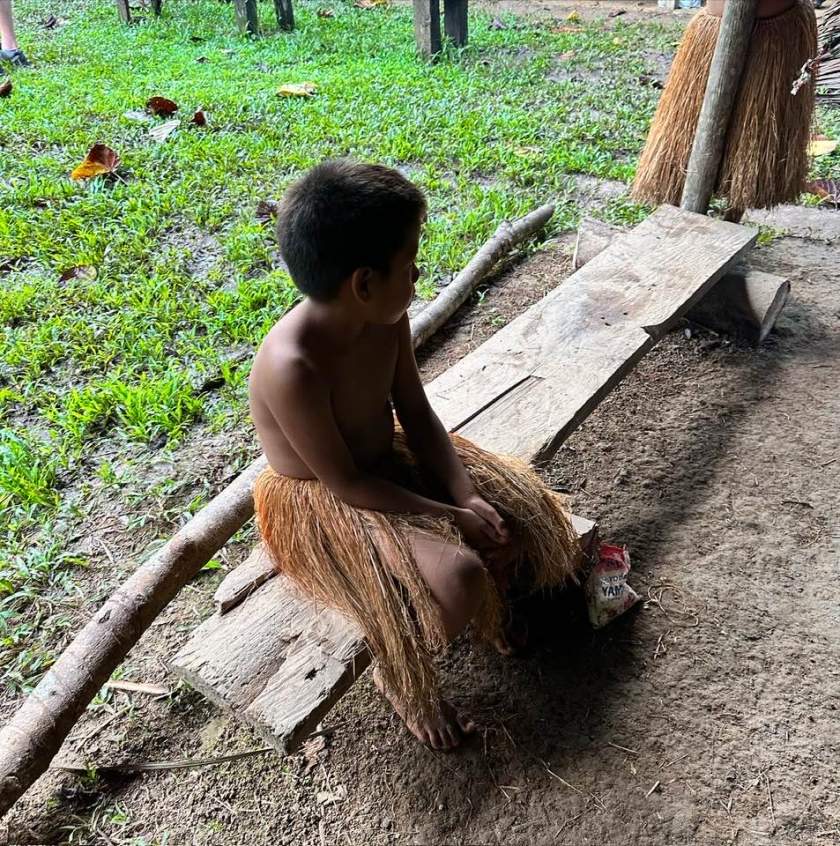
These, we were told, were the Yagua tribe. They number about 50 people of varying ages and you couldn’t meet nicer people.
Theirs is a simple life, but a beautiful one. Cut off from all of modern society, they use river water and kerosene lamps in lieu of electricity.

As we entered the huts, young children rushed up to us and used their thumbs to paint our cheeks with achiote–a blood-red substance made from the annatto plant. Then, they grabbed our hands and invited everyone to march in what was described as a “friendship dance” around the hut.

Everyone who participated held hands with one or more members of the Yagua.
My friend Joel was holding the hand of one particular little girl who had something furry hanging off of her. A circle or two later, April and I realized—to our absolute glee—that it was a sloth!
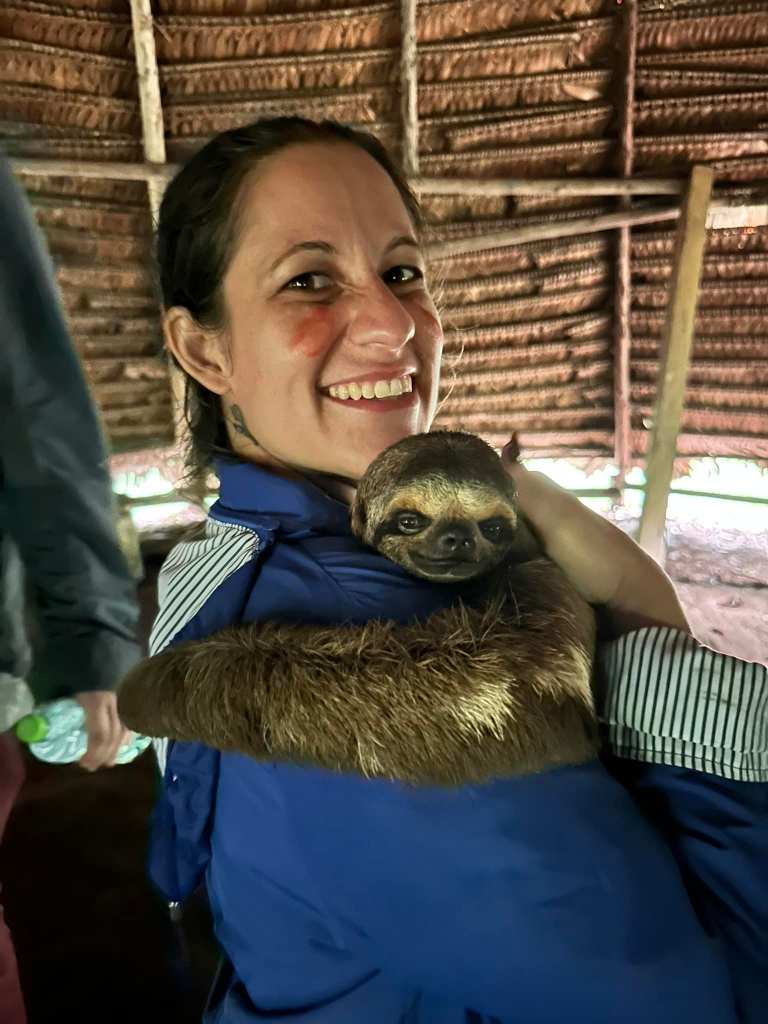
A real, honest-to-god, wild sloth was just hanging off of her little body. It turns out, she and this sloth have bonded and now she keeps it as a pet. It’s name is Rosita and all of us took turns, after the dance, holding her and falling head-over-heels. She’s so sweet and looks at you with the most lazy, loving smile. So, naturally, now I want one. I wonder how my fur children would react to a sloth sibling?
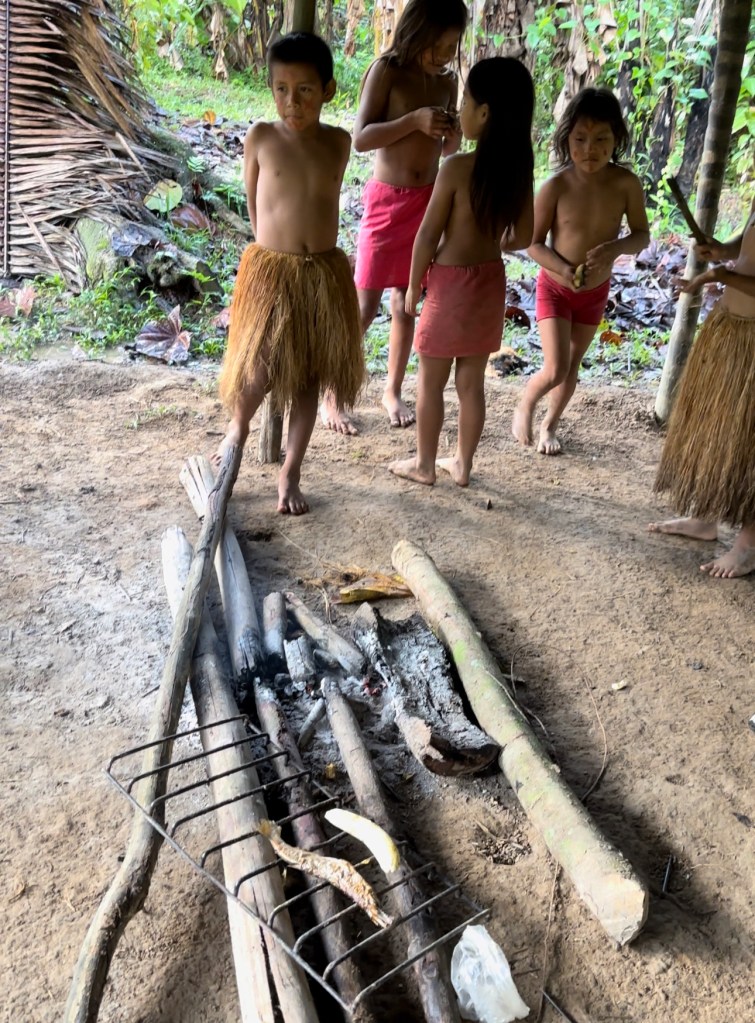
After the friendship dance, we were invited to the other thatched huts, where other children and their parents showed us how they cook fish and bananas over hot embers. They also sold jewelry and various wares, including piranha jaws and toucan bills on necklaces.
Note: everything they sold was super inexpensive, but they don’t offer change if you buy anything, so be prepared for that if you do go to visit them.
Out in the middle of the field, one of the men taught us how he shoots poisonous darts to hunt.
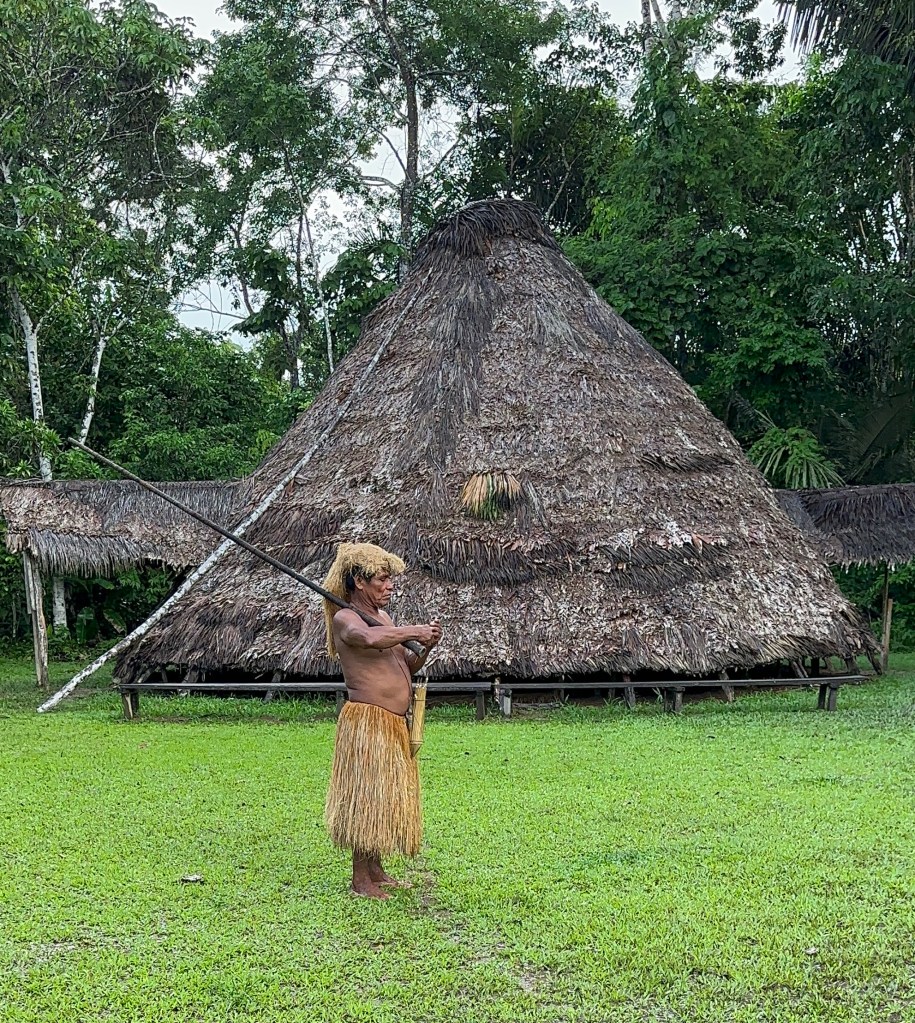
These darts are made from plants and then dipped in poison from frogs found in the jungle. The shoots—which are actually comprised of two channels that look like one—are hand-carved from palms and must be absolutely straight to work properly. I looked down the barrel of one of them and it was so precise that you’d think a machine did it.
The guide showed us how they stick powder from one of the flowers in the barrel to plug one of the tubes and shoot the dart forward with their breath. The darts are dipped in a poison made from tree frogs and other agents that, combined, cause lethargy.
Some of the group tried shooting darts at a target and they actually didn’t do too bad.
Max bought a miniature one for 40 S, which means it was just over $10, and yes–it does come with (non-poisonous) darts and it does work. The only thing missing is the piranhia jaw that they normally carry, which is used for sharpening darts.
While I’m a woman very accustomed to modern conveniences, I can’t help but envy the simplicity of life here.
We bid the Yagua farewell, including Rosita the sloth, and piled back into the boats just in time to catch the sunset as we turned left to head back up the river. As the sky turned pink and gold, we turned to our left to see a perfect silvery full moon rising above the trees.
A lovely way to wind down such a wonderful experience.
*Disclaimer: the Yagua like having their picture taken. Every photo posted here was taken and shared with their consent.
Cheers.

Kara Adamo is a globe-trotting ex-bartender, booze nerd, and booze writer. She is the author of Fancy Grape Juice: De-Snootifying the World’s Snootiest Beverage; Artimals: Coloring the Whimsical Wild; and Brews & Hues: A Coloring Book About Beer.
Adamo is a digital nomad, working as a UX writer and UX designer.
She is writing her fourth book, Layers of Cake.
 Karita's Travels